
Juicing has become a lifestyle trend, and for a good reason. But not all juicers are created equal. If you’re wondering how does a cold press juicer work and why it’s all the rage, you’re not alone. Cold press juicers, also known as masticating juicers, have taken over kitchens and health bars because of their ability to deliver nutrient-packed juice that tastes fresh and vibrant.
So, what’s the magic behind it? Let’s peel back the layers and squeeze out the truth.
Understanding the Basics
How Juicing Works in General?
Before go into how does a cold press juicer work, let’s explain how juicing works. It is the process of extracting the liquid content from fruits and vegetables. The goal is to separate the juice (the good stuff) from the fiber and pulp (also good, but not always needed).
While traditional juicers like centrifugal juicers use fast-spinning blades, cold press juicers go about it in a more gentle, deliberate way. Cold press juicer slowly crush the produce to extract juice from it. We will discuss more details on its process in later part of this article.
Before that let’s learn about some interesting history of juicing.
Brief History and Evolution of Juicing
Juicing has a long and fascinating history that dates back thousands of years. Ancient civilizations like the Egyptians, Indians, and Chinese were among the first to extract juice from fruits and herbs for medicinal and spiritual purposes. In Ayurveda, fresh juices were commonly used for healing, while Egyptians prized pomegranate juice as both a remedy and a symbol of vitality.
The real turning point in juicing’s evolution came in the 20th century with Dr. Norman W. Walker, a health pioneer often credited with modernizing juice extraction. In the 1930s, he invented the Norwalk Hydraulic Press Juicer, which used a slow grinding and pressing method to extract nutrient-rich juice without heat—essentially the foundation of today’s cold press juicing.
By the mid-1900s, centrifugal juicers hit the market, offering a quicker way to juice using fast-spinning blades. While they were convenient, they also introduced heat and oxidation, which degraded the nutritional quality of the juice. Despite this, juicing gained popularity among fitness enthusiasts and health-conscious individuals.
In the 2000s, with growing interest in raw foods and clean eating, cold press juicers began to shine. These machines offered higher nutrient retention, better juice yield, and less oxidation. As juice bars and wellness cafes boomed, cold-pressed juice became a staple in detoxes, weight loss plans, and everyday wellness routines.
Today, cold press juicing blends ancient wisdom with modern technology, giving us the ability to enjoy fresh, enzyme-rich juice right at home. From temple rituals to high-tech kitchens, the evolution of juicing shows just how timeless and essential this practice has become for health lovers around the world.
Different Types Of Juicers
When looking to add a juicer to your kitchen routine, it is important to understand the different types of juicers available on the market.
There are three main types of juicers:
- Masticating juicers,
- Centrifugal juicers, and
- Cold press juicers.
Masticating juicers grind, crush, and chew fruits and vegetables to extract juice and are best for leafy greens and wheatgrass.
Centrifugal juicers use a fast spinning blade to break down fruits and vegetables and extract juice, and are best for hard fruits and vegetables.
Cold press juicers use a slow, pressing motion and are best for extracting juice from soft fruits and vegetables. Cold press juicers are the most efficient in terms of extracting the most juice out of produce, and are the most popular type of juicer today.
Difference Between Cold Press and Traditional Juicers
Traditional juicers (like centrifugal ones) operate at high speed, which generates heat and causes oxidation. This can degrade nutrients and change the taste. Cold press juicers? They’re the slow and steady tortoises of the juicing world. No heat. No rush. Just pure, clean juice with all the goodness intact.
The Science Behind Cold Press Juicing
What Makes it “Cold”?
Contrary to what some might think, “cold” doesn’t mean the juicer chills your juice. It refers to the absence of heat during the extraction process. Since there’s no fast spinning or blade friction, the juice maintains more of its natural nutrients and enzymes.
The Role of Slow Masticating Technology
At the heart of every cold press juicer is masticating technology. The machine slowly grinds produce using an auger, mimicking the way we chew food. This slow crushing squeezes juice out of the ingredients while preserving flavor, vitamins, and enzymes.
Basic Functionality Of A Cold Press Juicer
Cold press juicers work by slowly crushing and pressing fruits and vegetables to extract their juice. The process is much slower than that of a centrifugal juicer but the resulting juice is much richer in flavor and nutrition.
The basic functionality of a cold press juicer involves a slowly turning auger that crushes the food into a pulp and then squeezes the juice out. It is also equipped with a filter to remove any remaining solids.
The entire process is done at a low temperature, ensuring that the heat from the motor does not affect the flavor or nutritional value of the juice.
Core Components of a Cold Press Juicer
Hopper
This is the top opening where you insert your fruits and veggies. Some juicers have wide hoppers for less prep.
Auger (Masticating Screw)
The auger is the hero here. It rotates slowly to crush and grind the produce into pulp, extracting juice along the way.
Juice and Pulp Outlet
One outlet channels the fresh juice, while another ejects the leftover dry pulp. Efficient separation is key to quality juicing.
Motor Base and Controls
The motor powers the auger, typically running at 40-100 RPM. You’ll usually find basic on/off and reverse controls for jams.
What Is the Mechanism of a Cold Press Juicer?
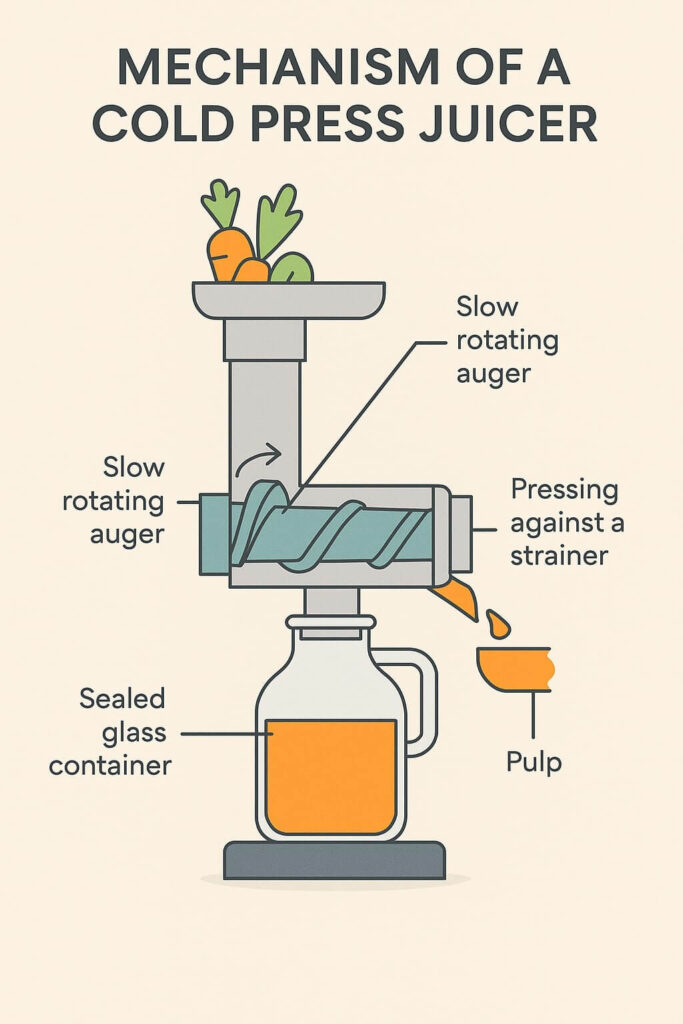
A cold press juicer, also known as a masticating juicer, works by slowly crushing and pressing fruits and vegetables to extract juice.
Here’s a brief breakdown of the mechanism:
- Slow Rotating Auger: The juicer uses a slow-turning auger (usually around 40–100 RPM) to crush the produce.
- Pressing Against a Strainer: The crushed produce is then pressed against a fine mesh strainer to separate the juice from the pulp.
- Minimal Heat & Oxidation: The slow process generates little heat, preserving more nutrients, enzymes, and flavor compared to high-speed juicers.
This gentle extraction is why it’s called “cold” press—no heat is involved that could degrade nutritional content.
Step-by-Step Process of Cold Press Juicing
Making juice with a cold press juicer is an easy way to get the most out of your produce. To start, prepare the fruits and vegetables and follow the steps mentioned below –
Step 1: Preparing Fruits And Vegetables
After selecting the fruits and vegetables for your cold press juicing, it’s time for preparation. For the most part, you can just rinse the fruits and vegetables under running water. However, some items—such as potatoes, apples, and carrots—may need to be peeled. You should also remove any seeds, pits, or stems that may be present.
Once prepped, cut the fruits and vegetables into small cubes to ensure they can fit through the cold press juicer’s feed chute. If needed, you can also use a grater or a spiralizer if you’re looking for a special texture. After everything is prepped, you’re ready to start your cold press juicing!
Step 2: Feeding the Produce
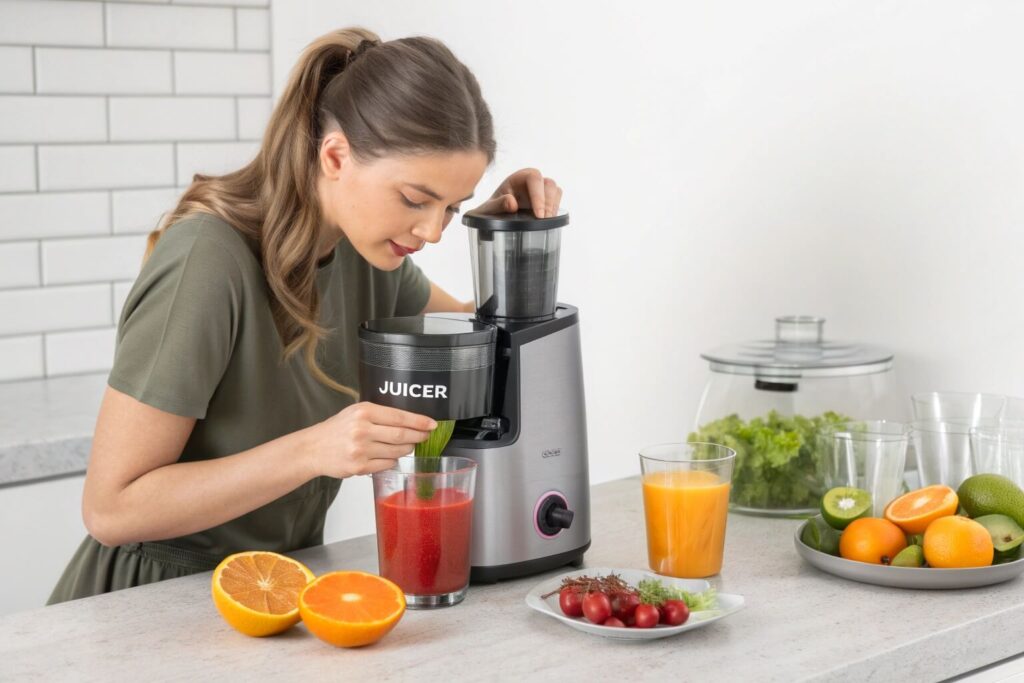
Once the produce is prepared, assemble the parts of the cold press juicer if they are disassembled. Plug in the juicer, switch it on, and adjust the settings, if necessary. Place the produce into the feeder tube, one piece at a time, and press down with a pusher to activate the augers.
Step 3: Crushing and Pressing
The auger slowly crushes the produce against a mesh screen, squeezing out every drop.
Step 4: Juice Separation
The juice flows through the screen into a collection container, while the pulp is pushed out separately. Most cold press juicers have built-in strainers, but if yours does not, you can strain it with a sieve or nut milk bag.
Step 5: Collecting the Juice and Pulp
Now you have your nutrient-rich juice in one container and dry, reusable pulp in another.
Advantages of Cold Press Juicing
Cold press juicers are a popular choice for making fresh, nutrient-rich juices. These juicers work by pressing produce through a slow-moving auger, which produces less heat and oxidation than traditional juicers. The benifites of cold press juicing are as follows:
Higher Nutrient Retention
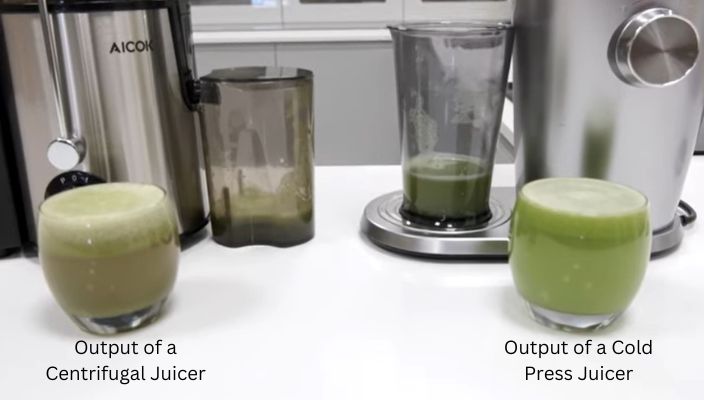
One of the standout benefits of cold press juicers is their ability to preserve nutrients at a much higher level compared to traditional juicers. Why? Because cold press juicers don’t produce heat during the extraction process. Unlike centrifugal juicers that spin at extremely high speeds and generate heat, cold press juicers operate slowly and gently crush produce using an auger. This low-speed process ensures that enzymes, vitamins, and minerals stay intact.
When you expose fruits and veggies to heat and oxidation, it leads to nutrient degradation—especially with sensitive compounds like Vitamin C and certain antioxidants. That’s where cold press juicers shine. They protect these fragile nutrients by minimizing heat and air exposure, which means your body gets more of the good stuff in every glass.
Imagine this: drinking a juice that feels alive—vibrant in color, rich in flavor, and bursting with the original nutrients from raw ingredients. That’s the magic of cold pressing. It’s like getting the best of your produce without sacrificing quality for speed. Especially if you’re juicing leafy greens, herbs, and soft fruits, a cold press juicer does an amazing job of extracting not just juice, but the full nutritional spectrum.
For health enthusiasts, athletes, or anyone using juice as a wellness booster, this nutritional advantage can make a real difference in energy levels, immune support, and digestion. You’re not just sipping juice; you’re fueling your body with a nutrient-dense elixir.
Longer Shelf Life of Juice
Another key benefit of cold press juicers is that they produce juice with a significantly longer shelf life. This is crucial for people who love to batch juice or prepare drinks in advance for a few days. The reason behind this extended shelf life lies in how cold press juicing limits oxidation and heat exposure.
When fruits and veggies are juiced using centrifugal machines, the spinning blades expose the juice to high temperatures and air, leading to rapid degradation. This causes the juice to spoil faster and separate quickly.
Cold press juicers avoid this pitfall. They work slowly and seal out air, resulting in less oxidation, which in turn keeps the juice fresher for up to 72 hours—or even longer when properly stored.
Have you ever noticed how store-bought cold-pressed juices can sit in refrigerated sections for days? That’s because the same low-heat, low-oxidation process preserves them. While homemade cold-pressed juice doesn’t undergo pasteurization, it still retains better stability when refrigerated in airtight containers like glass jars.
This benefit is perfect for busy individuals or families. Instead of juicing daily, you can prepare your week’s juice in one or two sessions, saving time while still enjoying delicious, nutrient-rich drinks. It’s not only practical but also cuts down on food waste and cleaning time—two major wins for any home kitchen.
Better Yield and Less Waste
When it comes to juicing, efficiency matters. Cold press juicers are champions in getting every last drop out of your fruits and vegetables. Compared to centrifugal juicers, they extract significantly more juice, especially from leafy greens, wheatgrass, and soft fruits like berries or tomatoes.
Why does this happen? Because the slow crushing and pressing mechanism is designed to apply more consistent pressure over time. Instead of tearing the produce with high-speed blades, the auger methodically breaks down cell walls, releasing juice from every part of the fruit or vegetable. What’s left behind is incredibly dry pulp—a sure sign you’ve gotten your money’s worth from every apple, carrot, or kale leaf.
This higher juice yield means you use fewer ingredients for the same amount of juice. In the long run, this translates into cost savings—both from buying less produce and wasting less food. It also makes cold press juicers more environmentally friendly. Less waste going into your compost or trash bin is always a good thing.
And let’s not forget, the higher efficiency also delivers better flavor. Since more juice is extracted from the fiber, you get fuller, more vibrant flavors that reflect the original ingredients more accurately. Your green juice tastes greener, your orange juice brighter, and your beet juice earthier.
Cold press juicers don’t just make juice—they maximize it.
Best Choice for Leafy Greens
If you’re someone who loves incorporating leafy greens into your daily routine—think kale, spinach, Swiss chard, parsley, or wheatgrass—then a cold press juicer is absolutely your best bet. Why? Because these types of greens are notoriously difficult to juice efficiently using centrifugal machines. Their fibrous and delicate structure often results in poor juice yield and lots of wasted pulp. That’s where the cold press juicer truly shines.
Thanks to its slow, grinding motion and strong pressing capability, a cold press juicer can extract significantly more juice from leafy greens than any fast-spinning counterpart. It methodically crushes the cell walls and fibers of these plants, squeezing out all the liquid with minimal waste. The result? A glass of deep green, nutrient-dense juice that feels like liquid vitality. Plus, you’ll be amazed at how dry the leftover pulp is—proof of how efficient the extraction really is.
Let’s talk flavor. Cold press juicing brings out the true essence of greens. It delivers a smoother, less bitter juice that’s easier to drink—even for people who aren’t fans of that typical “green” taste. The slower process keeps the natural sugars and subtle flavors intact, so your juice has more depth and balance.
Another perk is the cold press juicer’s ability to handle small batches. Want to juice a handful of spinach or a few leaves of kale without needing a ton of produce? No problem. Cold press juicers can efficiently juice even small quantities, which makes them perfect for specialty green shots or daily detox drinks.
Noiseless Operation
Because cold press juicers run slowly and have a lower motor power than centrifugal juicers, they produce much less noise, allowing you to make juice without disturbing other members of your family, particularly children.
Additionally, cold press juicers are easier to clean, making them a convenient option for busy households.
Benefits of cold press juicer at a glance-
- Instead of using quickly spinning blades, it uses a gradual masticating process.
- It separates the juice from the pulp, which is dryer than with other techniques.
- Compared to other juicers, it operates more gently.
- Nutrient loss is minimized, and less foam is produced.
- Compared to other juicers, it is quieter.
- It is simple to maintain and clean.
What are the Disadvantages of a Cold Press Juicer?
Here are some brief disadvantages of cold press juicers:
- Cost – They are generally more expensive than centrifugal juicers.
- Slower Juicing Process – Cold press juicers extract juice more slowly, which can be time-consuming.
- More Prep Work – You often need to cut fruits and vegetables into smaller pieces to fit the chute.
- Heavier and Bulkier – They take up more counter space and are heavier to move or store.
- Cleaning Can Be Tedious – Some models have multiple parts that require thorough cleaning.
Comparing Cold Press to Centrifugal Juicers
Nutrient Comparison
Cold press juicers win here, hands down. They keep more nutrients, making the juice more beneficial for your health.
Noise Levels
Cold press juicers are whisper-quiet compared to the roaring engines of centrifugal juicers.
Ease of Cleaning
They may take a few more minutes to clean, but many come with specialized brushes and dishwasher-safe parts.
Here is a details comparison table between cold press juicers and centrifugal juicers:
| Feature | Cold Press Juicer | Centrifugal Juicer |
|---|---|---|
| Juicing Method | Slow pressing using an auger | High-speed spinning with a blade |
| Speed | Slow (40–100 RPM) | Fast (up to 15,000 RPM) |
| Juice Quality | Higher nutrient retention, less oxidation | Lower nutrient retention, more oxidation |
| Noise Level | Quiet | Loud |
| Suitable for Leafy Greens | Yes | Not very efficient |
| Cleaning | More parts to clean | Fewer parts, easier to clean |
| Price | Generally more expensive | More affordable |
| Juice Shelf Life | Up to 72 hours | Best consumed immediately |
Is Cold Pressed Juice Better than Blender?
Yes, cold-pressed juice is generally considered better than juice made with a blender if you’re aiming for pure juice without fiber.
Here’s a brief comparison:
Cold-pressed juicers extract juice by slowly crushing fruits and vegetables, preserving nutrients and enzymes, and producing a smooth, pulp-free juice.
Blenders mix everything together, including fiber, resulting in a thicker smoothie rather than juice. This can be more filling but may be harder to digest quickly.
In short: Cold-pressed juice is better for nutrient absorption and digestion speed, while blender drinks are better for fiber intake and satiety.
Ideal Fruits and Veggies for Cold Press Juicing
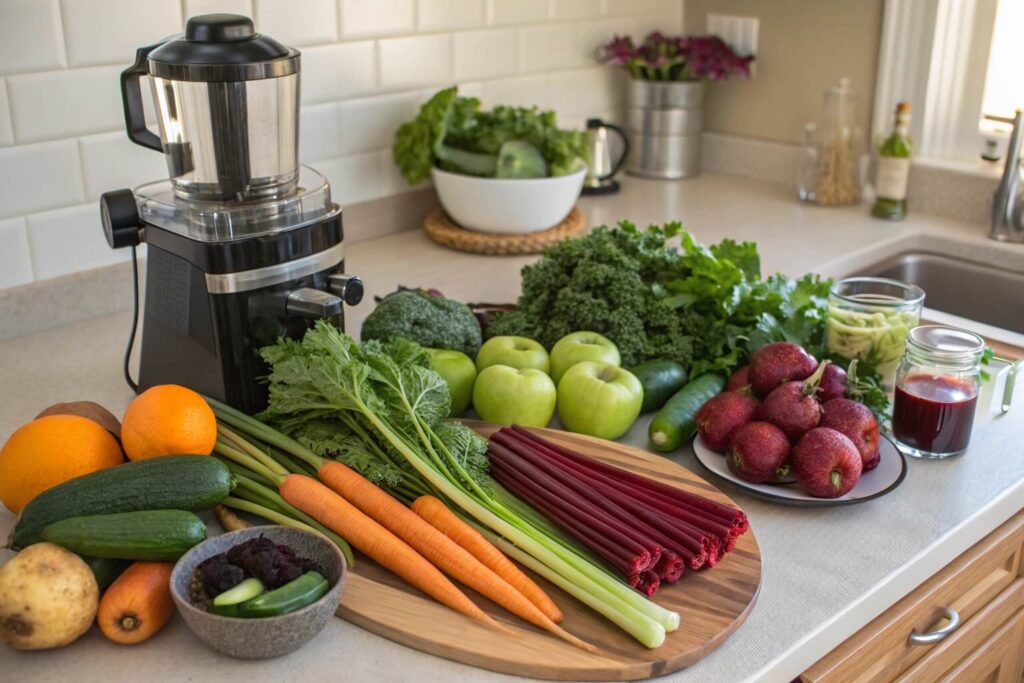
Best Choices for Maximum Juice
- Carrots
- Apples
- Celery
- Kale
- Cucumbers
- Beets
What to Avoid
- Overripe bananas (they’re too mushy)
- Avocados (they don’t juice)
- Stone fruits unless pitted
Can You Put Ginger in a Cold Press Juicer?
Absolutely, yes—you can (and should) put ginger in a cold press juicer! Ginger is one of the best ingredients to juice with a cold press machine because of its dense texture and potent health benefits. Unlike soft fruits that might require more finesse, ginger roots are tough and fibrous, which makes them ideal candidates for the slow, crushing motion of a cold press juicer.
Cold press juicers work by slowly grinding and pressing ingredients using an auger, which applies firm pressure to break down even the hardest of produce—ginger included. This method allows you to extract the maximum amount of juice from ginger root while preserving all its natural oils, antioxidants, and anti-inflammatory compounds. Plus, because the process doesn’t generate heat, all the beneficial enzymes and nutrients in ginger remain intact.
Ginger juice packs a punch. It’s spicy, aromatic, and loaded with compounds like gingerol, which has powerful anti-inflammatory and antioxidant properties. Whether you’re adding a small piece for flavor or juicing a larger amount for shots or health tonics, cold press juicers handle it with ease. In fact, many people regularly use their cold press juicers to make ginger shots, mixing ginger with lemon, turmeric, or apple for a strong immune boost.
That said, there are a few things to keep in mind:
- Cut ginger into smaller pieces to help the auger process it smoothly.
- Peeling is optional, but recommended if the skin looks dirty or rough.
- Don’t overload the juicer with only ginger; mix it with other ingredients to help it move through the machine evenly.
In short, ginger and cold press juicers are a perfect match—offering both power and precision for flavorful, nutrient-rich juices.
Tips for Better Juicing Experience
Prepping Produce Properly
Cut ingredients into small chunks. It helps the auger work efficiently and prevents jams.
Layering for Flavor
Mix sweet and earthy ingredients—like apple and beet—for balanced flavors.
Cleaning Hacks
Rinse parts immediately after juicing to prevent residue build-up. A quick soak in warm water goes a long way.
Myths and Misconceptions About Cold Press Juicers
Cold Press Means Cold Juice?
Nope. It means no heat is used in extraction, not that the juice comes out chilled.
They’re Too Slow?
Sure, they’re not speedy—but good things take time, right? The quality is worth the wait.
Centrifugal juicers and cold press juicers operate at very different speeds—and this difference plays a big role in how they extract juice and preserve nutrients.
- Centrifugal Juicers: These machines typically spin at 6,000 to 14,000 revolutions per minute (RPM). That’s incredibly fast. The high-speed blade shreds fruits and vegetables quickly, and the centrifugal force separates the juice from the pulp. While this speed is great for saving time, it also generates heat and oxidation, which can break down nutrients and shorten the juice’s shelf life.
- Cold Press Juicers (Masticating Juicers): These juicers work much slower, usually around 40 to 120 RPM. Instead of spinning, they use an auger to crush and press the produce. This slow process minimizes heat buildup and exposure to air, preserving more enzymes, vitamins, and minerals in the juice.
In short, centrifugal juicers are fast but less efficient in terms of nutrient retention, while cold press juicers are slower but deliver higher-quality, nutrient-dense juice.
Who Should Use a Cold Press Juicer?
Health Enthusiasts
Cold press juicing is ideal for those on detoxes or clean eating routines.
Busy Professionals
Make a big batch and store it—morning fuel ready to go!
Families with Kids
Sneak in greens with apple or orange—your kids won’t even notice.
Common Mistakes to Avoid
- Shoving too much produce in at once
- Skipping regular cleaning
- Using ingredients that aren’t meant for juicing
Maintenance and Longevity
Daily Cleaning Tips
Rinse all parts right after use. Don’t let pulp sit and harden.
Deep Cleaning Weekly
Use baking soda and vinegar to scrub down screens and filters.
Storage and Care
Store in a dry area. Don’t wrap cords tightly to avoid motor damage.
Buying Guide for Beginners
What to Look for in a Cold Press Juicer
- Easy to assemble and clean
- High juice yield
- BPA-free parts
Price vs Features
More expensive doesn’t always mean better. Focus on your needs and lifestyle.
Brand Recommendations
Try brands like Hurom, Omega, or Kuvings for long-lasting, high-quality machines.
Conclusion
Cold press juicers are the real deal for anyone serious about juicing. They work slowly and deliberately to give you juice that’s not just fresh, but full of nutrients your body will thank you for. Whether you’re a fitness buff, a busy mom, or just trying to eat (and drink) a little healthier, understanding how does a cold press juicer work can change the way you think about juice forever.
FAQs: How Does a Cold Press Juicer Work?
1. Is cold press juice healthier than store-bought?
Absolutely. Store-bought juice is often pasteurized, which kills nutrients. Cold press juice is fresh and loaded with vitamins and enzymes.
2. Can I juice leafy greens with a cold press juicer?
Yes! In fact, they’re excellent for extracting juice from greens like spinach, kale, and wheatgrass.
3. How long does cold press juice last?
Up to 72 hours if stored in a sealed glass container in the fridge.
4. Can kids drink cold press juice?
Definitely. Just keep it balanced and avoid strong flavors like ginger unless they’re used to it.
5. Are cold press juicers worth the money?
If you’re serious about health and juicing regularly, then 100% yes—they’re an investment in wellness.